
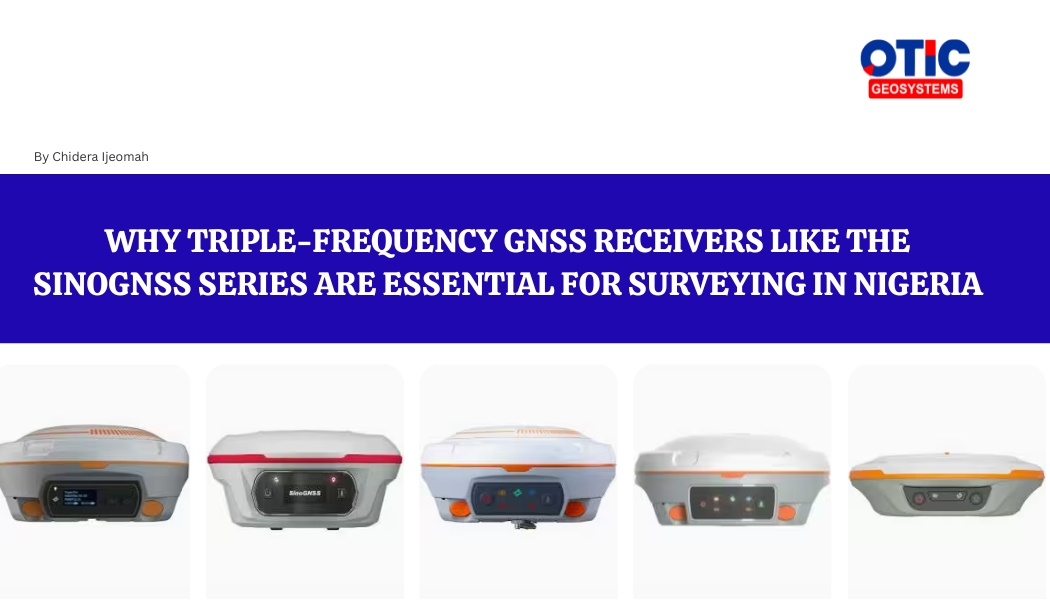
Surveying has evolved significantly over the past decade. With increasing demands for faster data acquisition, higher positional accuracy, and reliable performance in difficult environments, the choice of GNSS receiver has become more critical than ever. While many surveyors still use single-frequency or dual-frequency receivers, modern triple-frequency GNSS receivers such as the SinoGNSS T20, T30, Jupiter Laser RTK and Mars Laser RTK provide substantial advantages, particularly within Nigeria's diverse terrain and challenging operating conditions.
Understanding Triple-Frequency GNSS
A triple-frequency GNSS receiver tracks satellite signals on three different frequencies simultaneously (for example L1, L2, and L5 for GPS, alongside equivalent frequencies from BeiDou, Galileo, and GLONASS).
Unlike single or dual-frequency receivers, triple-frequency technology enables the receiver to resolve positioning ambiguities more quickly while improving signal reliability and reducing measurement errors.
Why Triple Frequency Receivers Matters in Nigeria
1. Faster RTK Initialization
One of the greatest frustrations for surveyors is waiting for an RTK fixed solution.
Nigeria's urban environments such as Lagos, Abuja, Port Harcourt, Kano, and Onitsha contain numerous buildings, communication masts, and reflective surfaces that interfere with GNSS signals.
Triple-frequency receivers process additional satellite information, enabling them to:
- Obtain RTK Fixed solutions much faster
- Recover quickly after signal interruptions
- Reduce waiting time in the field
Example:
A surveyor conducting a cadastral survey in Victoria Island, Lagos, may lose satellite lock due to high-rise buildings. A SinoGNSS triple-frequency receiver regains an RTK fixed solution much faster than many dual-frequency receivers, allowing work to continue with minimal downtime.
2. Superior Performance Under Tree Canopies
Many Nigerian projects involve:
- Forest reserves
- Agricultural plantations
- Rural communities
- Oil and gas pipeline routes
- Transmission line surveys
Dense vegetation weakens satellite signals.
Triple-frequency receivers provide stronger signal tracking and improved ambiguity resolution under partial canopy, reducing the need to clear vegetation before taking measurements.
Example:
During a boundary survey in Cross River State's forested areas, a SinoGNSS triple-frequency receiver maintains accurate positioning where older dual-frequency units frequently lose RTK fixes.
3. Better Resistance to Multipath Errors
Multipath occurs when satellite signals bounce off nearby structures before reaching the receiver.
This commonly happens around:
- Concrete buildings
- Bridges
- Steel structures
- Ports
- Construction sites
Major Nigerian cities experience significant multipath interference.
Triple-frequency receivers use advanced algorithms to better distinguish direct satellite signals from reflected signals, resulting in:
- Higher positional accuracy
- More reliable measurements
- Reduced repeat observations
Example:
During a construction survey around Eko Atlantic City or Apapa Port, multipath effects are common. Triple-frequency receivers significantly improve data reliability compared with older GNSS equipment.
4. Improved Accuracy in CORS Networks
Nigeria's adoption of Continuously Operating Reference Station (CORS) networks continues to expand.
Triple-frequency receivers maximize the benefits of modern CORS corrections by processing more satellite observations simultaneously.
This results in:
- More stable RTK solutions
- Better coordinate repeatability
- Higher confidence in survey results
This is especially valuable for engineering, cadastral, and infrastructure projects requiring centimetre-level accuracy.
5. Greater Satellite Availability
Modern triple-frequency receivers track multiple GNSS constellations, including:
- GPS
- BeiDou
- Galileo
- GLONASS
- QZSS
- SBAS
This often means tracking well over 1,000 channels, depending on the model.
More satellites provide:
- Better geometry
- Improved accuracy
- Increased reliability
- Fewer interruptions
This advantage is especially noticeable during cloudy conditions or when parts of the sky are obstructed.
6. Increased Productivity
Time equals money in surveying.
Every minute spent waiting for an RTK fix reduces productivity.
Because triple-frequency receivers:
- initialize faster,
- maintain fixes longer,
- recover more quickly after interruptions,
survey teams can complete significantly more work each day.
A team completing 100 survey points daily with an older receiver may be able to increase output by 15–30% simply by using a modern triple-frequency receiver under similar field conditions, depending on site conditions and workflow.
7. Better Investment for the Future
GNSS technology continues to evolve.
New satellite signals are increasingly designed for modern multi-frequency receivers.
Purchasing a triple-frequency receiver ensures compatibility with future satellite services and correction systems, extending the useful life of the equipment.
Why Surveyors Choose SinoGNSS Triple-Frequency Receivers
SinoGNSS has become one of the fastest-growing GNSS brands worldwide by combining advanced technology with cost-effective solutions.
Some standout features include:
- Triple-frequency multi-constellation tracking
- Fast RTK initialization
- Excellent performance in challenging environments
- IMU tilt compensation (available on selected models)
- Long battery life
- Rugged IP67-rated construction
- Compatibility with CORS and radio RTK
- User-friendly field software
- Strong after-sales support, training, and calibration through OTIC GEOSYSTEMS
Popular models include:
- SinoGNSS T20 RTK
- SinoGNSS T30 RTK
- SinoGNSS Mars Laser RTK
- SinoGNSS Jupiter Lase RTK
These receivers are suitable for:
- Land surveying
- Engineering surveys
- Construction layout
- Hydrographic positioning
- Mining
- GIS mapping
- Precision agriculture
- Utility mapping
- Road and railway projects
Practical Nigerian Applications
Triple-frequency SinoGNSS receivers are particularly valuable for:
- Lagos: High-rise developments and dense urban environments where multipath is common.
- Abuja: Road construction, smart city planning, and engineering surveys requiring rapid RTK fixes.
- Niger Delta: Pipeline routing and oil-and-gas infrastructure surveys in areas with thick vegetation.
- Northern Nigeria: Large-scale agricultural projects and precision farming, where broad satellite coverage improves operational efficiency.
- South-East Nigeria: Boundary and cadastral surveys in mixed urban and rural landscapes.
Conclusion
Nigeria's surveying industry is becoming increasingly technology-driven. As infrastructure projects grow in complexity and clients demand greater accuracy and faster delivery, surveyors need equipment capable of performing reliably in all conditions.
Triple-frequency GNSS receivers such as the SinoGNSS T20, T30, Jupiter Laser RTK and Mars Laser RTK provide clear advantages over older single- and dual-frequency systems. Their ability to acquire RTK fixes quickly, resist multipath interference, maintain accuracy under canopy, and leverage modern multi-constellation satellite networks makes them a practical choice for today's professional surveyor.
For organizations seeking to improve productivity, reduce field delays, and deliver consistently accurate results, investing in a triple-frequency receiver is not just a technological upgrade, it is a strategic investment in long-term performance and competitiveness.
OTIC GEOSYSTEMS is an authorized supplier of SinoGNSS solutions in Nigeria, offering equipment sales, technical training, calibration, maintenance, and after-sales support to help survey professionals maximize the value of their GNSS investment.